


Free Samples Available
Qualified projects can receive free product samples
Qualified projects can receive free product samples
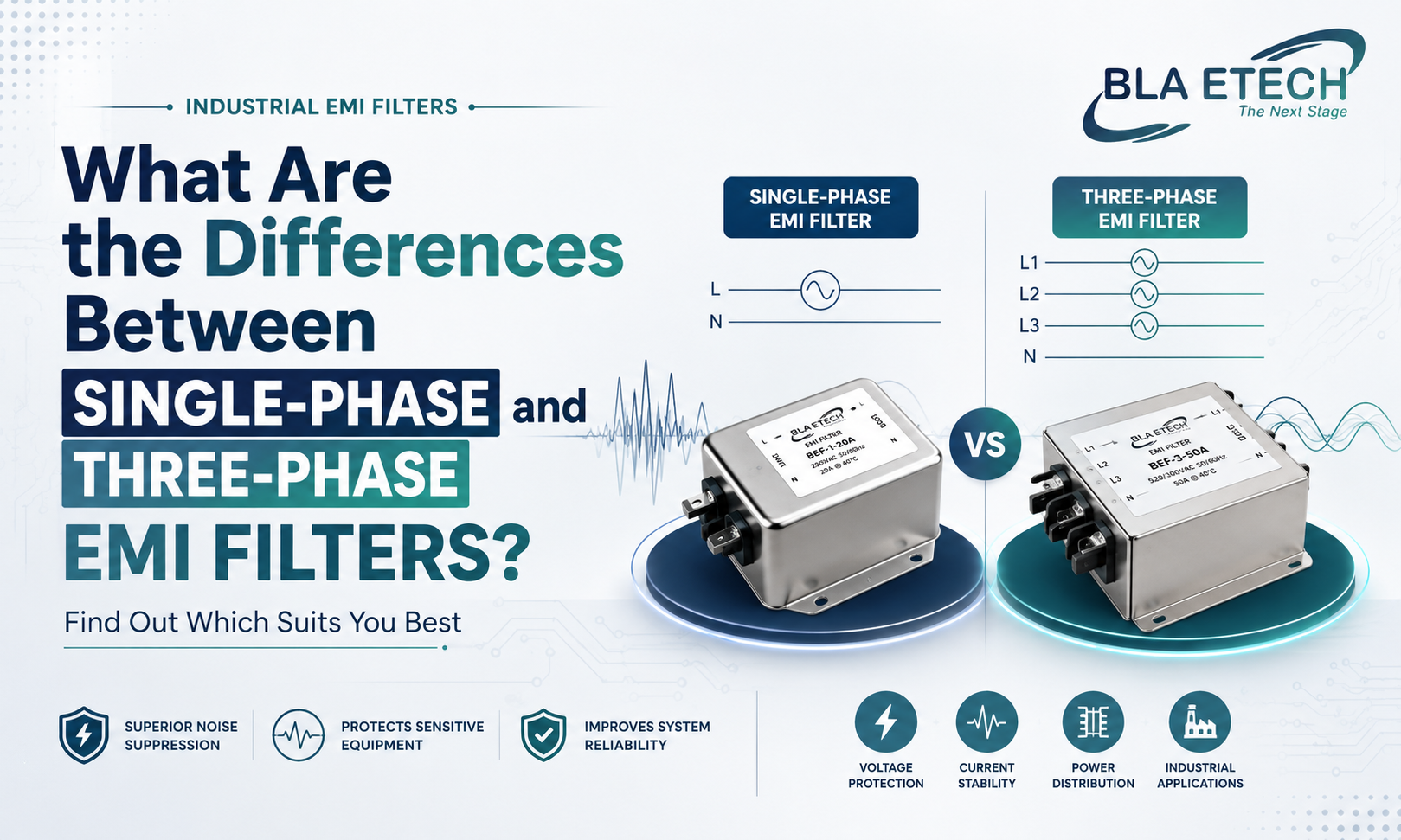
One of those invisible issues that engineers, procurement managers, and facility operators have to deal with every day, but only talk about when something goes wrong, is electrical noise. From a sensitive medical instrument that is malfunctioning to an industrial motor drive that is throwing errors, electromagnetic interference is the silent cause of many performance problems. The selection of the appropriate EMI filter is not a mere technical requirement. This choice has a direct impact on equipment lifespan, compliance, and reliability. The most frequent question that buyers in Europe, the UK, and the USA have is: "Should I use a Single phase EMI filter or a Three phase EMI filter? They both have the same basic function, but they are very different in terms of application, architecture, and performance. Knowing those differences will help you make a more informed and cost-effective decision. It is important to understand the function of these components before making a comparison. An EMI filter is a filter that is used to reduce high-frequency conducted electromagnetic interference that is carried by power lines. This interference may be generated by the equipment (outgoing noise), by the mains supply (incoming noise), or both. This noise can interfere with sensitive electronics, cause equipment malfunctions, and result in failure to meet regulatory requirements like EN 55011 in Europe or FCC Part 15 in the USA without adequate filtering. The filter is used to block unwanted frequency components and let clean power pass. A Single phase EMI filter is designed for systems that are powered by a two-wire power supply, usually one live and one neutral conductor, with a protective earth. This is the typical configuration for light commercial applications, residential applications, and many smaller electronic devices. Single phase filters are generally used in office equipment, household appliances, medical devices on standard supply voltages, audio and communication electronics, and low-power industrial equipment. The filter is capable of filtering common-mode noise and differential-mode noise, and can be used in a wide range of applications with relatively low power requirements. Design-wise, single phase filters are generally smaller and easier to incorporate. They come in a wide current range and are compact enough for use in enclosures with limited space. A Three phase EMI filter, on the other hand, is designed for systems that are connected to a three-phase power supply. This is the standard configuration for industrial machinery, large HVAC systems, motor drives, CNC equipment, power conversion systems, and any high-current application where the load requires more capacity than a single phase supply can practically provide. Three-phase systems split the current into three live conductors, thereby lowering the peak current per conductor and enabling greater power delivery. In such a system, the EMI filter has to handle the interference in all three phases and have a balanced filtering performance. The design is more complex, and the physical size is more complex. For applications where three phase power is already used, however, the installation of a compatible three phase filter is not a choice from a compliance or performance perspective. A single phase filter would not be able to provide sufficient noise reduction on all three phases of a three phase system. The main difference is the power supply. Single phase filters are used with one live conductor, three phase filters are used with three live conductors. Other than that, the differences are natural consequences of the application environment. Three phase filters are larger, more expensive, and can be used for higher current loads. Single phase filters are lighter, smaller, and appropriate for lower power applications. There is also a compliance consideration. European, UK, and USA regulatory requirements define EMC requirements depending on the type of installation. Even if the attenuation performance on paper is good, if the wrong type of filter is used, it will not be compliant. Once you know your system parameters, the decision framework is simple. Begin with the supply voltage and phase configuration that is already installed at your site. Next, think about the current rating you need, the range of frequencies of interference you want to block, and the size of your enclosure. It is also important to use a supplier that understands the application context, not just the component specification. BLA Etech is just such an application-aware expert. BLA Etech has a long history of supplying both single phase and Three phase EMI filters to industrial and commercial customers throughout Europe, the UK, and the USA, and is supported by technical staff. Having an EMI filter company that can help you with the selection and supply is a practical benefit for buyers who are facing procurement decisions with tight schedules. BLA Etech has that dual capability, product availability, and real application knowledge. The decision between a Single phase EMI filter and a Three phase EMI filter is a matter of matching the solution to the system. Do it right, and you'll be protected from interference, regulation, and better equipment reliability. If you get it wrong, you could end up with issues that could have been avoided. For those who are in the process of specifying a new installation or are looking at an existing installation, BLA Etech is a good place to begin for accurate product guidance and supply in all major markets.What is an EMI Filter?
Single phase EMI filters: Where They Fit
Three phase EMI filter: Designed for more demanding applications.
The Key Differences at a Glance
How to Select the Appropriate Filter for Your Application
The Right Filter Protects More Than Just Compliance


